

Artificial Intelligence (AI), Machine Learning (ML), and Deep Learning (DL) can be used as synonyms, however, they are not identical. It is important that businesses and students, as well as every person who attempts to make sense out of modern technology, understand the difference between these terms.
In this article, the author breaks down AI vs Machine Learning vs Deep Learning and how each relates and presents real-world examples of each.
What Is Artificial Intelligence (AI)?
The three concepts are the most generalized as Artificial Intelligence. In AI, machines or software are considered intelligent in human-like ways and can be used to execute functions that would otherwise be handled by human intelligence.
These tasks include:
- Rational thinking and problem-solving.
- Understanding language
- Learning from experience
- Making decisions
- Perceiving images and speech
AI systems are not necessarily learned by data. Others are rule-based i.e. they adhere to set instructions that are written in the form of instructions by humans.
Applications of Artificial Intelligence.
- Rule-based chatbots
- Chess-playing programs
- Voice assistants
- Recommendation engines
- Fraud detection systems
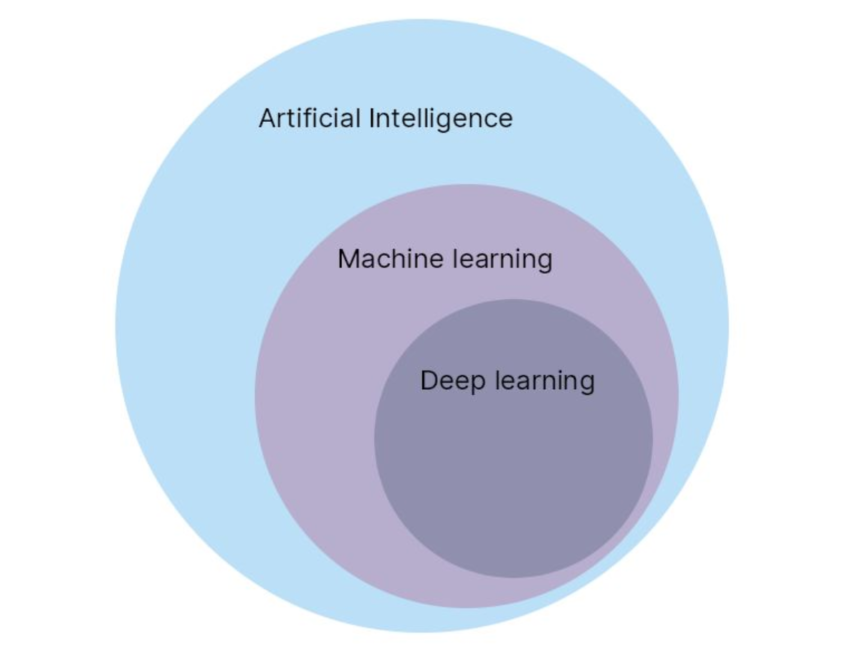
👉 Key takeaway: AI is the umbrella term that includes both Machine Learning and Deep Learning.
What Is Machine Learning (ML)?
Machine Learning is a subset of Artificial Intelligence. ML systems are not programmed to perform certain tasks specifically, but they learn and become better over time by means of data.
Machine learning algorithms detect trends in data and apply the trends to make predictions or decisions.
How Machine Learning Works
- Data is collected
- The data are trained on an algorithm.
- The model learns patterns
- The model uses predictions on new data.
Types of Machine Learning
- Supervised Learning: Uses labeled data (e.g., spam detection)
- Unsupervised Learning: Finds patterns in unlabeled data (e.g., customer segmentation)
- Reinforcement Learning: Learns through trial and error (e.g., game-playing AI)
Examples of Machine Learning
- Email spam filters
- Product recommendations
- Credit scoring systems
- Predictive analytics
- Customer churn prediction
👉 Key takeaway: Machine Learning allows AI systems to learn from data without being explicitly programmed.
What Is Deep Learning (DL)?
Deep Learning is a branch of Machine Learning, and it is based on the human brain design. It uses artificial neural networks based on multiple layers (hence deep) to determine associations on large volumes of data.
Deep learning automatically learns features in raw data eliminating the manual feature engineering process.
How Deep Learning Is Different
- Requires large datasets
- Applies elaborate neural networks.
- Needs high computational power (GPUs/TPUs)
- Skills unstructured information such as images, audio and text.
Examples of Deep Learning
- Facial recognition systems
- Speech recognition (voice assistants)
- Self-driving cars
- Image classification
- Models of language translation.
👉 Key takeaway: Deep Learning is powerful but resource-intensive and best suited for complex tasks.
Artificial Intelligence vs Machine Learning vs Deep Learning: Major Differences.
| Feature | Artificial Intelligence | Machine Learning | Deep Learning |
| Scope | Broad concept | Subset of AI | Subset of ML |
| Learning Required | Not always | Yes | Yes |
| Data Dependency | Low to high | Moderate | Very high |
| Human Intervention | High | Medium | Low |
| Complexity | Low to high | Medium | High |
| Best For | Rule-based tasks | Predictions & analytics | Images, speech, NLP |
Real-World Use Cases Compared
Artificial Intelligence Applications.
- Rule-based automation
- Virtual assistants
- Game AI
- Decision-support systems
Machine Learning Use Cases
- Fraud detection
- Demand forecasting
- Recommendation engines
- Predictive maintenance
Deep Learning Use Cases
- Autonomous vehicles
- Medical image analysis
- Voice recognition
- Natural language processing (NLP)
How AI, ML, and DL Work Together
Reconsider the relationship in the following manner:
- Artificial Intelligence is the goal: machines that act intelligently.
- Machine Learning is one way to achieve AI.
- Deep Learning is an advanced technique within Machine Learning.
ML is not used in every AI application, and deep learning is not used in every ML application, but most contemporary AI applications make use of one or both.
Which One Should You Use?
- Use AI for rule-based automation and decision systems
- Predict and understand with Machine Learning.
- Deep Learning should be used with complicated tasks such as images, speech, or text.
The selection of the appropriate approach requires:
- Data availability
- Problem complexity
- Budget and infrastructure
- Accuracy requirements
Conclusion
The difference between Artificial Intelligence, Machine Learning, and Deep Learning help us to understand the way modern technologies operate and how they find their applications in the real world.
The general idea is AI, Machine Learning which allows systems to learn through data, and Deep Learning, are the strongest AI-powered applications that we can find today. Together, they are at the core of intelligent systems that run innovation in industries.