

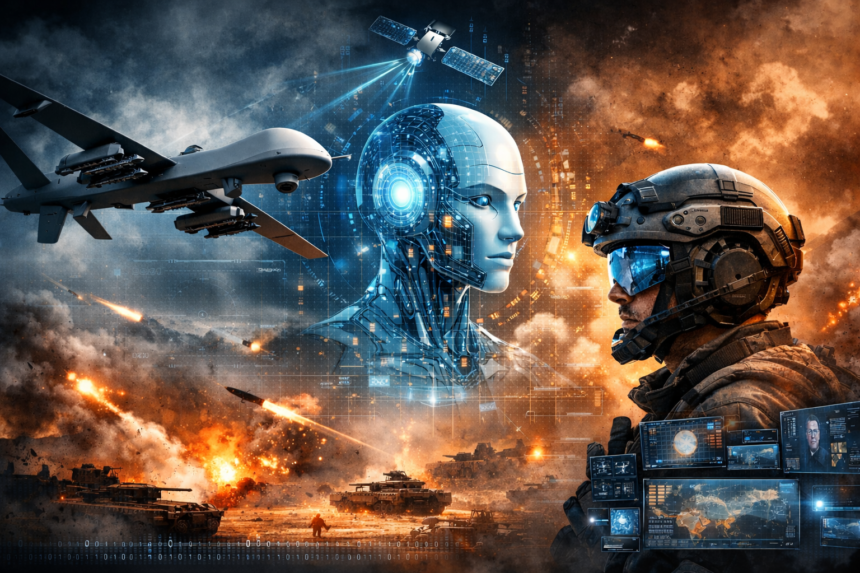
Artificial Intelligence (AI) is transforming the nature of modern warfare rapidly. Since autonomous drones and intelligent surveillance systems, militaries all over the world are adopting AI technologies to gain strategic benefits in the battlefield.
Recent tension and military-related issues between Iran and Israel have demonstrated how AI-based technologies are influencing intelligence gathering, targeting, and even information warfare. Through these technologies, the armies are able to process large volumes of data, identify threats more quickly and make tactical decisions in real time.
However, the increased involvement of AI in military affairs also poses some grave questions about ethical, legal, and security concerns.
In this article, we explore the ways AI is transforming contemporary warfare in four dimensions, which include: AI-powered drone targeting, AI surveillance systems, automated military decision systems and AI misinformation detection.
1. AI-Powered Drone Targeting
The use of AI-powered drones as a type of surveillance and precision strikes is one of the most apparent examples of AI application in modern warfare.
Drones are equipped with machine learning algorithms and computer vision systems that enable their detection of possible targets, movement tracking, and battlefield environments analysis. These functions greatly lower the time required to identify and to be able to communicate with enemy assets.
For example, loitering munitions like the IAI Harop can hover over a battlefield for extended periods before striking a detected target. These systems combine the functions of drones and missiles, enabling high-precision attacks once a target is identified.
Iran has also invested heavily in drone technologies such as the Mohajer 10, which can carry weapons and conduct surveillance missions for up to 24 hours across long distances.
In the recent conflicts, the AI has been used to aid the military systems to process the data given by drones at a faster speed, enhancing targeting accuracy and lowering the time to react.
However, analysts caution that over dependence on automated targeting systems could rise chances of errors in case AI systems misunderstand data or work with outdated intelligence.
2. AI Surveillance Systems
The other significant change in warfare today is due to AI-based surveillance and intelligence systems.
The AI has become a tool of military forces to process massive amounts of data that come in the form of satellites, drones, communication networks, and even online public sources. These tools help intelligence agencies detect patterns, monitor troop movements, and identify potential threats much faster than traditional methods.
Surveillance systems based on AI can work with:
Satellite imagery
Drone video feeds
Social media activity
Electronic communications
In conflicts involving Iran and Israel, analysts have reported the use of open-source intelligence (OSINT) combined with AI to track military movements and identify strategic targets.
This is in a way that even publicly available information like a social media post or geographical metadata can be processed by AI systems to obtain useful intelligence.
As a result, modern warfare increasingly relies on data analysis and digital monitoring, not just traditional battlefield operations.
3. Automated Military Decision Systems
One of the most controversial developments in military AI is the use of automated decision-support systems.
These systems use machine learning algorithms to analyze real-time battlefield data and recommend strategic actions to commanders.
For example, AI tools can:
Prioritise military targets
Predict enemy movement
Suggest optimal attack strategies
Manage missile defense systems
During recent military operations, AI-assisted tools have been used to help analyse intelligence and generate target suggestions at a rapid pace. In some cases, these systems have helped identify dozens of potential targets per hour during active combat operations.
Supporters argue that such technologies improve efficiency and reduce human error. However, critics warn that excessive reliance on automated decision-making could increase the risk of unintended civilian casualties if human oversight is insufficient.
The challenge for militaries is finding the right balance between AI efficiency and human control.
4. AI and the Battle Against Misinformation
Modern warfare is no longer limited to physical battlefields. Information warfare has become a critical part of geopolitical conflicts.
AI-generated content such as deepfake videos, manipulated images, and automated propaganda has become a powerful tool for influencing public opinion.
During recent Iran-related conflicts, large amounts of AI-generated misinformation circulated on social media platforms. Some fake images and videos falsely depicted military events or fabricated battlefield victories.
To combat this problem, governments and technology companies are developing AI-powered misinformation detection tools.
These systems analyze digital content to identify:
Deepfake videos
Synthetic images
Coordinated propaganda campaigns
Bot-driven social media manipulation
As AI continues to advance, the struggle between AI-generated misinformation and AI-powered detection tools will become a central element of future conflicts.
Ethical Challenges of AI in Warfare
While AI provides military advantages, it also raises serious ethical questions.
Key concerns include:
Lack of transparency in AI decision-making
Risk of civilian casualties from automated systems
Potential escalation of conflicts due to rapid decision cycles
Global AI arms races between nations
Experts warn that autonomous weapons could destabilize global security if regulations and oversight are not established.
International organizations and governments are now debating how to regulate AI-driven weapons and ensure that humans remain responsible for critical military decisions.
The Future of AI Warfare
The Iran–Israel conflict highlights a broader shift in military strategy worldwide.
Future wars may increasingly rely on:
Autonomous drone swarms
AI-driven cyber warfare
Real-time battlefield analytics
Automated defense systems
Countries that successfully integrate AI with military strategy will likely gain significant strategic advantages.
At the same time, the global community must address the ethical and security challenges posed by these technologies.
Conclusion
Artificial Intelligence is reshaping the nature of warfare in ways that were unimaginable just a decade ago.
From AI-powered drones and intelligent surveillance systems to automated decision-making tools and misinformation detection, technology is becoming a central force in modern military strategy.
The evolving Iran–Israel conflict provides a clear example of how AI is transforming warfare into a data-driven, technology-powered domain.
As AI continues to develop, the future of global security will depend not only on technological innovation but also on responsible governance and international cooperation.
FAQs
Can AI control Military Weapons?
AI will help in targeting and decision-making processes but, the majority of the military regimes still need human confirmation to launch attacks.
What is the significance of drones in modern warfare?
Drones enable armies to perform surveillance and precision attacks without affecting the lives of human pilots.
How does AI used in military intelligence work?
AI assists in the analysis of huge volumes of information about satellites, sensors, and websites to identify threats more quickly.
Is AI warfare dangerous?
Yes. Analysts warn that robotic weapons and artificial intelligence decision making systems may pose more dangers when not controlled.
Interested in how artificial intelligence is shaping the future? Explore more AI insights and automation trends on The Tech Turtle to stay updated with the latest innovations.