


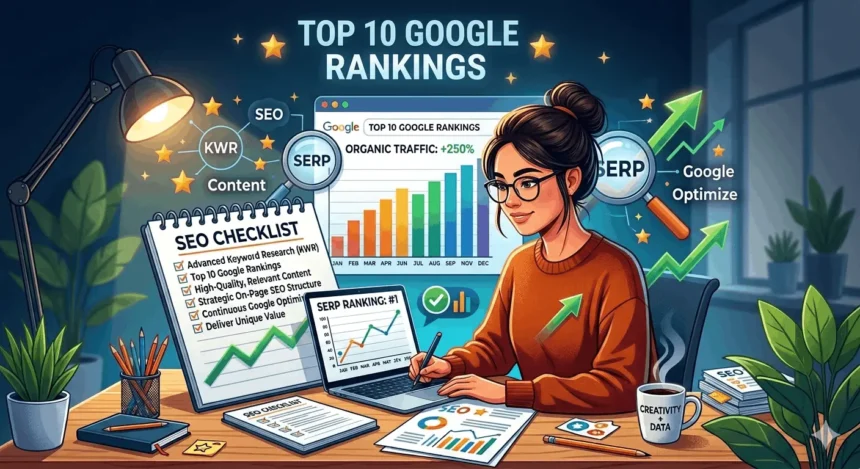
Here’s the hard truth: You can write beautifully — and still get zero traffic. Why? Because great writing without SEO strategy is invisible to Google. In this guide, you’ll learn a step-by-step process to create SEO-friendly content that not only ranks but also drives real traffic.
- What Is SEO Content Writing?
- Why SEO Content Matters More Than Ever in 2026
- Step-by-Step Process to Write SEO Content
- STEP 1 – Do Keyword Research That Actually Works
- STEP 2 – Match Search Intent Precisely
- STEP 3 – Build a Content Structure Google Loves
- STEP 05 On-Page SEO Optimization — The Technical Essentials
- STEP 6 – Internal Linking — The Underrated Ranking Lever
- STEP 7 – Readability = Rankings (Don’t Skip This)
- SEO Content Writing Checklist — Before You Publish
- Common SEO Writing Mistakes That Kill Your Rankings
- Frequently Asked Questions
- How do I write SEO-friendly content as a complete beginner?
- How long should SEO content be to rank on Google?
- Can I use AI tools for SEO content writing?
- How long does SEO content take to rank?
- What’s the most important SEO content writing tip for beginners?
- Start Writing Content That Ranks
What Is SEO Content Writing?
SEO content writing is the craft of creating articles, blog posts, and web pages that are strategically built to rank high in search engine results — while genuinely helping the reader.
It’s the intersection of three disciplines: great writing, keyword strategy, and technical optimization. Remove any one of these, and your content underperforms.
In simple terms:
👉 It’s not just about writing—it’s about writing with purpose.
Why SEO Content Matters More Than Ever in 2026
Google’s algorithm has undergone massive changes. It no longer rewards keyword-stuffed articles. In 2026, rankings are driven by:
- Helpful, experience-driven content— Google’s EEAT (Experience, Expertise, Authoritativeness, Trust) framework is now central to ranking decisions.
- Search intent alignment— If your content doesn’t match what users are actually looking for, it won’t rank — period.
- User experience signals— Bounce rate, time-on-page, and Core Web Vitals all send ranking signals to Google.
- Content freshness— Outdated content loses rank. Regular updates signal authority.
For example, even technical factors like website speed can impact rankings. If your site is slow, it can hurt your SEO performance—here’s a guide on how to fix a slow website and improve performance.
Bottom line: the bar is higher. But so is the opportunity if you follow a proper SEO blog writing guide.
Step-by-Step Process to Write SEO Content
STEP 1 – Do Keyword Research That Actually Works
Primary keyword (your core topic):
how to write SEO content
Secondary keywords (support and reinforce the primary):
how to write SEO friendly content
SEO content writing tips
content writing for SEO beginners
how to optimize content for SEO
Long-tail keywords (low competition, high conversion):
how to write SEO content step by step
how to write blog posts that rank on Google
SEO content writing checklist
beginner SEO writing tips
how to write content for Google ranking
Use your primary keyword in your title, first paragraph, one H2, and meta description. Distribute secondary and long-tail keywords naturally in subheadings and body copy. Never force them.
STEP 2 – Match Search Intent Precisely
This is where most beginners fail. If you write an informational post for a transactional keyword (or vice versa), Google will not rank you — even if your content is excellent.
Ask yourself:
👉 What is the user actually looking for?
🔍Informational
“How to write SEO content” — the user wants to learn.
🛒Transactional
“Buy SEO writing course” — the user wants to purchase.
🧭Navigational
“Ahrefs login” — the user knows where they want to go.
⚖️Comparative
“Best SEO tools 2026” — the user is evaluating options.
Action step: Before writing a single word, Google your target keyword. Look at the top 5 results. Are they guides? Lists? Tools? Product pages? Match that format that’s what Google’s algorithm has already confirmed works for this query.
STEP 3 – Build a Content Structure Google Loves
Google prefers well-structured content. Your heading structure is a map — for readers and crawlers. A well-organized article gets more time on page, lower bounce rates, and stronger crawlability.
- H1 (one per page)— Your main title. Include your primary keyword naturally.
- H2s— Major sections. Use secondary keywords and related phrases here.
- H3s— Sub-points within sections. Great for long-tail keyword placement.
- Short paragraphs— 2–4 sentences max. White space increases readability.
- Table of Contents— Helps users navigate and can generate rich result sitelinks in Google
STEP 4 – Write Content That Earns Trust (Not Just Traffic)
Clicks mean nothing if people leave immediately. To keep readers engaged — and signal quality to Google — your content must deliver real value.
Write for humans first, then optimize for Google
This is the golden rule of content writing for SEO beginners. Use real examples, personal insights, and actionable takeaways. Avoid filler sentences that add words but zero value.
Apply EEAT principles
Experience: Share first-hand knowledge or case studies.
Expertise: Demonstrate subject mastery with accurate, deep information.
Authoritativeness: Link to credible sources and earn backlinks.
Trust: Be transparent, accurate, and consistent.
STEP 05 On-Page SEO Optimization — The Technical Essentials
Even exceptional content needs proper on-page signals to rank. Here’s your how to optimize content for SEO checklist:
Schema markup— Use Article or FAQ schema to enhance your Google result appearance.
Title tag— Include your primary keyword near the beginning. Keep it under 60 characters.
Meta description— 150–160 characters. Include the keyword and a compelling reason to click.
URL slug— Short, clean, keyword-rich. Example:/how-to-write-seo-content
First 100 words— Mention your primary keyword naturally in the opening paragraph.
Image alt text— Describe images accurately using relevant keywords where natural.
STEP 6 – Internal Linking — The Underrated Ranking Lever
Internal links do three powerful things: they distribute “link equity” across your site, help Google understand your site structure, and keep readers on your pages longer.
Aim for 2–5 internal links per article. Link to related guides, tools, or cornerstone content using descriptive anchor text (not “click here”). This is one of the most underused SEO content writing tips among beginners.
STEP 7 – Readability = Rankings (Don’t Skip This)
Google tracks how users interact with your content. If readers bounce quickly, your rankings drop. Readability directly impacts dwell time, engagement, and conversions.
Add visual breaks: images, dividers, highlighted quotes, and tip boxes.
Write at a Grade 7–8 reading level (use Hemingway App to check).
Use active voice over passive voice wherever possible.
Break up walls of text with bullet points, numbered lists, and callout boxes.
Use transition words (“however,” “as a result,” “additionally”) to improve flow.
SEO Content Writing Checklist — Before You Publish
✓ Primary keyword in H1, first paragraph, and at least one H2
✓Secondary and long-tail keywords placed naturally in body copy
✓Meta title under 60 characters with target keyword
✓Meta description 150–160 characters with a click-worthy hook
✓Content fully matches the search intent of the keyword
✓H2/H3 heading structure is clear and logical
✓2–5 internal links with descriptive anchor text
✓Images have descriptive, keyword-informed alt text
✓Content is at least 1,200 words (aim for 1,500–2,000 for competitive topics)
✓Readability checked — short paragraphs, simple language, good flow
✓Page loads in under 3 seconds on mobile
✓A clear CTA or next step is included at the end
Common SEO Writing Mistakes That Kill Your Rankings
✕
Writing without keyword research first. Guessing what people search for is almost always wrong. Data beats intuition.
✕
Ignoring search intent. Ranking for informational keywords with a sales page — or vice versa — will never work.
✕
Keyword stuffing. Repeating your keyword every few sentences triggers Google’s spam filters and destroys readability.
✕
Writing only for Google bots. If real humans don’t enjoy reading it, your engagement metrics will tank your rankings.
✕
Never updating old content. Articles older than 12–18 months start losing rank unless refreshed. Schedule regular content audits.
✕
Skipping internal linking. Every published article is a missed opportunity to link to your other content.
Frequently Asked Questions
How do I write SEO-friendly content as a complete beginner?
Start with keyword research using free tools like Google’s Search Console or Ubersuggest. Find one primary keyword, understand what type of content ranks for it (informational, list, guide), then write a well-structured piece that genuinely answers the reader’s question. Follow this guide’s checklist before publishing.
How long should SEO content be to rank on Google?
It depends on the keyword. For competitive informational keywords, aim for 1,500–2,000+ words. For local or transactional pages, 600–900 words may be enough. The real answer: match the depth of what’s already ranking on page one.
Can I use AI tools for SEO content writing?
Yes — strategically. AI tools are excellent for drafting outlines, generating keyword variations, and improving phrasing. But Google’s EEAT framework rewards genuine experience and expertise. Use AI to assist your writing process, not replace your unique perspective and insights.
How long does SEO content take to rank?
Typically 3–6 months for new content on a relatively new site. Established sites can rank in weeks. Factors include domain authority, competition level, and how well the content satisfies search intent. Patience and consistency are essential.
What’s the most important SEO content writing tip for beginners?
Master search intent before anything else. Write the right type of content for the right keyword, and half your SEO work is already done. No amount of keyword optimization saves a piece that fundamentally mismatches what the user is looking for.
Start Writing Content That Ranks
Bookmark this guide, save the checklist, and apply one step at a time. SEO is a compounding skill — the earlier you start, the bigger the returns
Read more Digital Marketing and SEO blog on The Tech Turtle